Nursing student clinical placement check-in Australia — this is the tool I wish someone had handed me on day one of my first placement.
Some students came to placement with their stethoscope, their uniform, their notebook.
And still had no idea what they were supposed to be doing.
Not because they weren’t trying. They were. They were working hard, asking questions, showing up early.
But when I asked — “What are you hoping to demonstrate today?” — I’d often get a blank look. Or a vague answer. Or they’d say something about the skill they wanted to practise, without connecting it to the standard it was linked to.
That gap stayed with me.
The thing nobody tells students clearly enough
Clinical placement isn’t just a chance to practise skills. It is a formal, structured assessment against the NMBA Registered Nurse Standards for Practice and the ANSAT Behavioural Cues.
Every shift counts. Every interaction is evidence.
But if a student doesn’t know what the assessor is actually looking for — if they can’t name the standard behind the thing they just did — they’re flying blind.
I’ve watched capable, caring students underperform in their summative assessment not because they weren’t competent, but because they couldn’t articulate their competence. They couldn’t point to a standard and say: “This is what I demonstrated, and here’s how.”
That broke my heart a little, every time.
So I made something
For a long time, I had my own version of a check-in guide. Something I’d built for myself — a way of tracking what students were demonstrating, shift by shift, so that when assessment time came, the evidence was already there.
I used it quietly, alongside whatever tools the university provided. It wasn’t fancy. But it worked.
Students who used it came to their assessments differently. More grounded. More specific. They’d say things like: “On Day 7 I assessed Mrs. T’s wound — I used the TIME framework, I identified two factors affecting healing, I documented the findings independently and had my buddy countersign. That’s Standard 4.2 and 6.1.”
That is what passing sounds like.
What I want for every nursing student
I’m not sharing this because I think students need more paperwork.
I’m sharing it because I genuinely believe that practising to a standard — not just practising generally — is what separates a student who gets through placement from one who grows through placement.
Whether you’re a nursing student on your first 4-week hospital placement, or a third-year student heading into your final 8-week block, the standards don’t change. The NMBA RN Standards for Practice and ANSAT Behavioural Cues are the same document that will govern your practice for your entire career.
Learning to see your work through that lens, early — that is a gift you give your future patients.
The check-in guide — what it actually is
These aren’t checklists for the sake of checklists.
Each item in the daily plan is tied to a specific NMBA Standard and a specific ANSAT Behavioural Cue — so when you tick something, you know exactly why it matters and what evidence it generates.
The weekend self-study plans bridge what happens on the ward to what needs to happen in your head. Pathophysiology, drug profiles, case studies, reflections. The shifts teach you what to do. The weekends teach you why.
And the reflection prompts at the end of each day? Those aren’t optional extras. That’s where the learning actually lands.
my experience: I’ve seen students fill in reflection prompts three minutes before leaving the carpark and students who sat in their car for twenty minutes genuinely processing what happened that day. The difference in their assessment performance was significant. Not because one was smarter. Because one was paying attention.
For Year 2 students
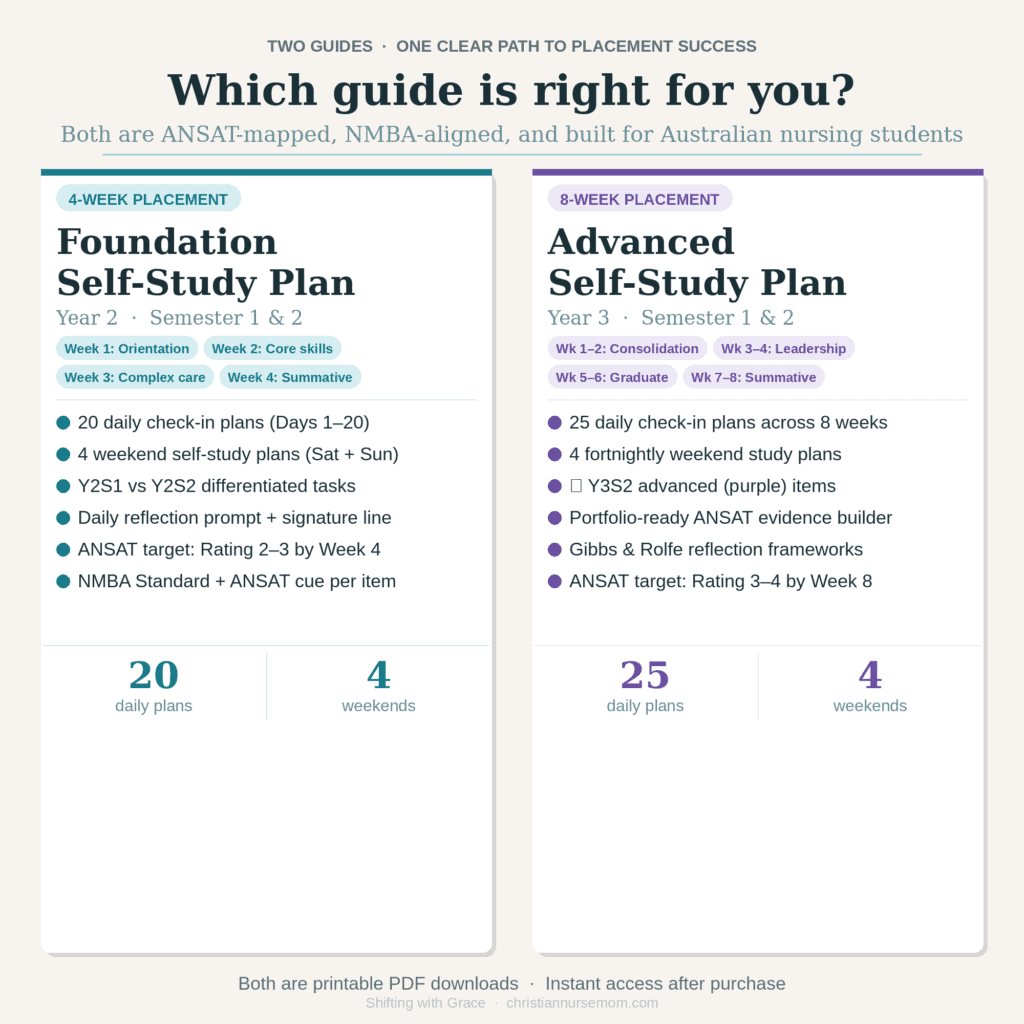
The 4-week guide is built around where you actually are.
Week 1 is orientation, communication, and your first real patient assessments. It is okay to feel overwhelmed. The guide gives you something concrete to hold onto.
Week 2 adds wound care, medications, care planning, and recognising deterioration. Every item has a Y2S1 version and a Y2S2 version — because a first-semester student and a second-semester student are not the same, and their expectations shouldn’t look identical.
Week 3 brings in complex patients, ethics, and MDT dynamics. This is where placement gets real.
Week 4 is consolidation — leading your own care, discharge planning, and walking into your summative assessment with actual evidence, not just hope.
For Year 3 students
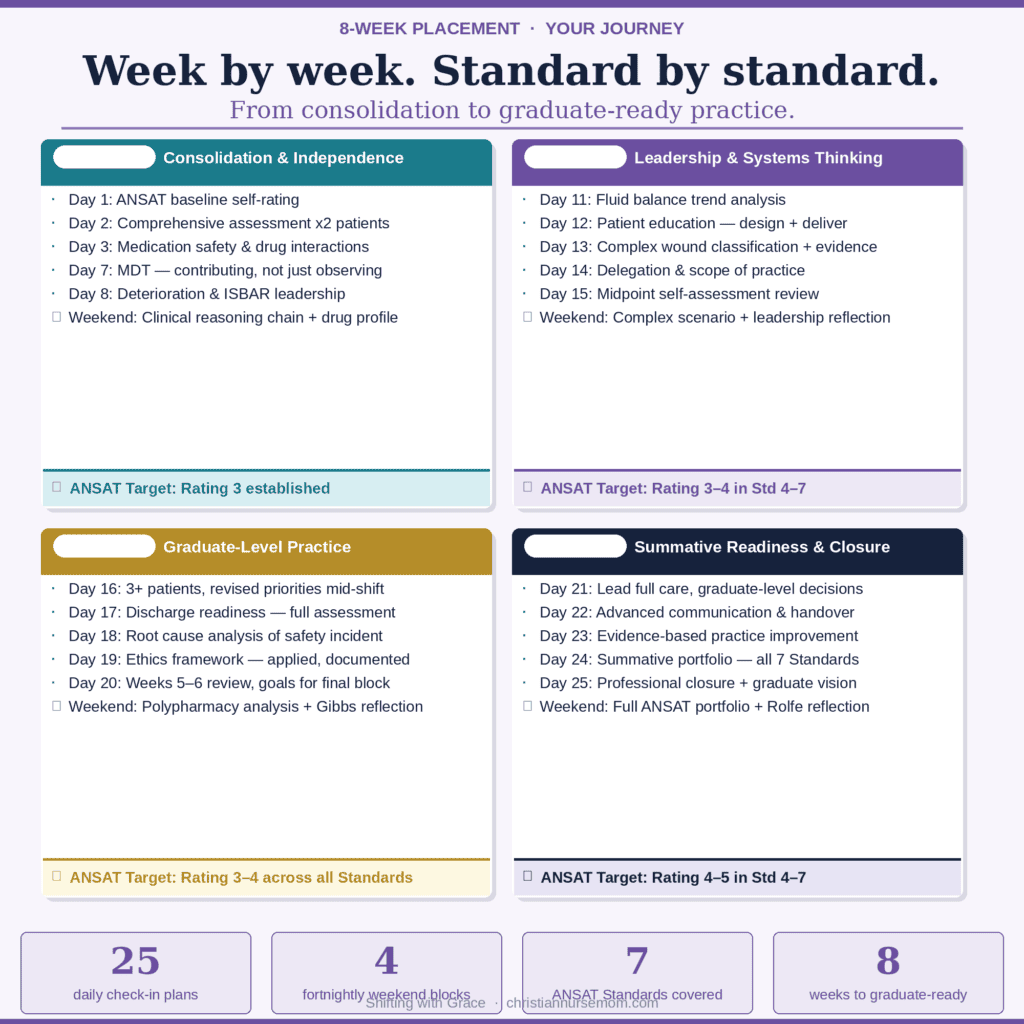
The 8-week guide is different in tone.
By Year 3, you’re not just learning nursing anymore. You’re becoming a nurse.
The daily plans expect more of you — clinical reasoning chains, trend analysis, polypharmacy thinking, ISBAR leadership. The purple-starred ★ items mark the Y3S2 advanced expectations: graduate-level independence, ethical frameworks applied to real dilemmas, quality improvement thinking.
By Week 8, you’ll have a complete ANSAT self-assessment portfolio. You’ll have written Gibbs reflections, complex case analyses, a discharge planning assessment, and a leadership moment documented.
And when your CC asks: “Tell me about your growth across this placement” — you’ll have an answer.
A note on standards — from one nurse to another
I want to say something that I say to every student I work with.
The NMBA Standards and ANSAT Behavioural Cues are not just boxes to tick for placement. They are the professional and ethical framework that holds nursing together.
Every time you introduce yourself properly to a patient — that’s Standard 2.1. Every time you look up the evidence before making a care decision — that’s Standard 1.1. Every time you debrief after a hard shift instead of just going home — that’s Standard 3.1.
Living these standards isn’t extra. It is the job.
And the earlier you internalise that — not just for assessment, but for practice — the better nurse you become. For your patients. For your team. For yourself.
✝️
I think about Colossians 3:23 a lot in nursing.
“Whatever you do, work at it with all your heart.”
Not with all your anxiety. Not with all your impostor syndrome. Not with all your worry about whether you’re doing enough.
With all your heart.
That looks like arriving on time and staying present. It looks like looking something up when you don’t know. It looks like writing an honest reflection on a hard day instead of pretending it was fine.
It looks like caring about your standard of practice — not because someone is watching, but because a patient’s life is on the other end of your decision.
These guides exist because I wanted to give students something that helped them do that. Something that turned good intentions into documented, standard-aligned, assessable growth.
I hope it sits on the seat next to you on the drive to placement.
I hope you tick boxes with your buddy at the end of a long shift and feel the quiet satisfaction of knowing exactly what you demonstrated today.
I hope that by Day 20, you look back at Day 1 and barely recognise yourself.
That’s the point.
→ Find the 4-Week Guide (Year 2) and 8-Week Guide (Year 3) in the Shifting with Grace Etsy shop
Both are printable PDF downloads. ANSAT-mapped. NMBA-aligned. Built for Australian nursing students, by an Australian nurse who’s sat on both sides of the assessment table.
Shifting with Grace — because every standard you meet is a patient kept safe.
Internal links to add:
→ Nurse Burnout in Australia: Signs, Symptoms & How Faith Helped Me